Rain quit Tuesday and there's still standing water up there, and a ceiling tile over the register is going soft.
Most of my commercial roofing in Mobile starts with a puddle like that. A summer thunderstorm rolls in around three like it has a shift to finish, and every flat roof in town gets graded on it whether it's ready or not. We work shops, warehouses and offices from Tillman's Corner out to Spring Hill: flat roofing, steel metal roofing, built up roofing, and the commercial roof repairs that keep a building dry while you plan the bigger job.
One thing that never happens on my jobs is coating sprayed over soaked insulation. It hides the problem for a season, the deck rusts under it, and you pay for the roof twice.
Square footage, how many curbs and units are up there, the condition of the decking, and whether a lift can reach the back of the building all move the number. Keep reading for how the work goes and the questions that come up before anybody signs, or call me at (251) 551-3653 and I will come up and look.
Steel Metal Roofing
Standing seam steel is what I want on any building sitting close to the bay, because an exposed fastener panel has thousands of screws in it and every neoprene washer under those heads is a slow leak waiting on salt air. I like 24 gauge Galvalume on concealed clips so the panel can move.
A 40 foot run grows and shrinks close to half an inch between a January morning and an August afternoon, and a panel pinned tight will chew its own fastener holes open by year three.
The detail crews skip is butyl tape in the seam and matching metals at the trim, because carbon steel screws against aluminum flashing corrode like they were paid to.
Gauge, roof geometry, penetrations and whether we tear off or go over the old deck are what move steel metal roofing one way or the other. Where panels are still tight, roof coatings for metal roofs buy real years instead. My crew also handles Mobile Siding Installation, so wall panel and roof trim actually line up where they meet.
Flat Roof Repair
Flat roof repair starts with a fact people forget: a flat roof isn't flat. It's built with about a quarter inch of fall per foot, and when that pitch flattens out, water sits. After a heavy downpour, ponding should be gone inside 48 hours. Still standing there Thursday? Something's wrong under the membrane, crushed insulation board, a drain bowl stuffed with pine straw and oak leaves, or a seam that's let go.
So we cut test squares and find the wet board first, instead of smearing mastic over the top and hoping. TPO and PVC patches get hot air welded, then probed with a seam tester so we know the weld took. Most leaks we chase live at flashings, curbs and drain bowls, not out in the open field.
How much soaked insulation is under there is what turns a small commercial roof repair into a real one.
Commercial Roof Repair
Most commercial roof repair calls start the same way: a stained ceiling tile over somebody's desk, and the hole is nowhere near it. Water travels. On a low-slope deck it will run fifteen or twenty feet along a flute before it finds a seam to drop through, so we trace it back to the source instead of smearing mastic on the nearest suspicious blister, which is what you get from commercial roofers working by the hour.
What actually fails around here: parapet flashing, pitch pans that have dried and split, seams that let go when a 95 degree afternoon meets a four o'clock thunderstorm, and drains packed solid with live oak leaves. Water still sitting up there two days after a storm is telling you something.
A patch laid over wet insulation seals the moisture in and the deck goes soft underneath. Most commercial roof repairs we make start where a wall meets the roof, so that is where we look first.
Built Up Roofing
Built up roofing is the old workhorse of flat roofing: ply after ply of asphalt saturated felt mopped down in hot asphalt, then a gravel surface or a cap sheet on top. Three plies is standard, four where people walk. Done properly, it'll go twenty to thirty years, even here, where we catch more rain than just about anywhere in the country.
Done badly, you get blisters. Trapped moisture between plies, August sun hits it, and the thing swells up like a Moon Pie in the microwave. Short laps at the seams are the other one. Both start small and both end in a tear off.
Strip, dry in and rebuild usually runs a few days to two weeks. Deck condition, parapet height and how many roof penetrations we have to flash decide where in that range you land.
Commercial Roof Replacement
Commercial roof replacement is what we recommend once patching has stopped paying you back: insulation squelching under the membrane, fasteners backing out, fresh stains on the ceiling tile after every storm.
We tear off to the deck, cut out rotted plywood or corroded decking, then rebuild the fall with tapered ISO so water actually reaches the drains instead of sitting in ponds all summer. Membrane goes down mechanically fastened or fully adhered depending on the deck and the exposure, and edge metal gets detailed to the wind spec we pull for your building, because a lazy termination is the first thing a squall line pries at.
Twenty thousand square feet usually runs a week to ten days, dried in each evening. Deck condition, layers up top and tight access around the back move that more than square footage does.
Industrial Roofing
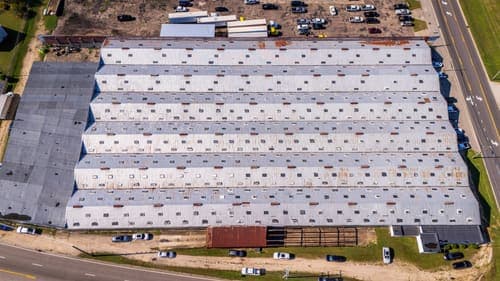
Warehouses out by Theodore Industrial Park and the plants along the Industrial Canal don't fail the way a shopping center does. They fail at the fasteners. Twenty years of Gulf heat cycling a metal deck backs those screws out a thread at a time, and once the neoprene washers dry up, every lap is a straw.
Industrial roofing on a live building means we work around your shift, not through it, and we don't drop a panel on a production line to save an afternoon.
Most of the time we're not tearing off. We're washing, treating rust at the laps, taping seams and putting silicone roof coatings for metal roofs over the whole thing, which buys you years without downtime. The office building out front usually needs help too, and that's when the Mobile Siding Installation crew rides along.
What the job involves
Every commercial roofing job I take starts with a core cut, not a quote sheet. We pull a plug the size of a coffee can, check whether the insulation under the membrane is wet, and count the layers already up there. Two is the limit before it all has to come off.
Then we handle the parts that get skipped: drains and scuppers, the curbs around your rooftop HVAC units, and the flashing where the parapet meets the field. That's where the leaks start. Almost never in the middle.
On metal, roof coatings for metal roofs go on after we replace fasteners and address the seams, never before. Coat over rust and you've rented a year.
A 10,000 square foot flat roofing job runs four to six days if the sky cooperates, and between June and October in Mobile, that's a genuine if. We schedule around the Gulf the same way we do with Mobile Siding Installation.
What it costs
What it costs starts with square footage, and the square footage is only half of it. A clean flat roofing job over sound decking prices at the low end. Wet insulation, rusted curbs and a tear-off down to bare deck push it up fast. Access moves it too. A warehouse with fifteen penetrations and nowhere to set a dumpster is nothing like rolling roof coatings for metal roofs across a single storefront.
Small commercial roof repairs get priced by the trip and the patch, so two leaks in one visit cost less than two visits.
Plenty of commercial roofing companies will quote you off a satellite photo. We would rather get up there and count what is actually wrong first. Ask us for a figure at (251) 551-3653.
A commercial roof replacement guessed from the ground turns into change orders the day the tear-off starts.
When commercial roofing is the wrong fix
Sometimes commercial roofing is the wrong answer, and I'd sooner say that in your parking lot than after a tear-off. A brown streak running down an interior wall a foot or two below the ceiling usually isn't the roof at all. It's water getting in at a wall panel seam or behind bad trim, and you can re-cover the whole deck and watch that stain come back with the next storm. What you actually want is siding repair.
Same story when the roof itself is tight but the lower wall panels have rusted through near grade. That's wall skin, not roofing.
And if it's a house, not a warehouse, with wood siding gone spongy under the paint or vinyl siding split at the nail line, hire us for the siding and leave the commercial roofers out of it.
Why choose us for this
Water's coming through the ceiling tiles, there's a bucket under it, and what you want is to hire commercial roofing contractors once and not think about that roof again for years. Fair enough.
So the number I put on paper covers the tear-off, the soft decking we find once the old membrane is up, and hauling every scrap of it off your lot. A cheaper quote usually gets cheap by leaving deck repair as a change order and making the old material your problem.
I don't lay new membrane over wet insulation to save a day, either. It blisters by the second summer and you pay for the same commercial roof repair twice.
I won't be your low bid. Your building gets dried in before we open another job, and the estimate puts you under no obligation to book anything.
Frequently asked questions
Can you repair my flat roof, or does the whole thing have to go?
Usually repair. If the insulation under the membrane is still dry and the trouble is seams, flashing or a tired drain, flat roof repair buys you several more years. Once water has spread through more than about a third of the deck board, a commercial roof replacement is the honest call. Patching over soaked insulation just seals the water in.
Will you have to shut my business down?
No. We stage the roof in sections and work around your hours, and most commercial roof repairs here run two to four days. Gulf storms build fast on summer afternoons, so we dry everything in before we leave each evening.
How do we get started?
Call me at (251) 551-3653 and I'll climb up and look myself. If the walls took the same beating, our Mobile Siding Installation crew can check those the same trip.
Contact Mobile Siding Pros now
Contact us now and I'll get someone on your roof this week with a tape measure, instead of quoting off a satellite photo the way a lot of commercial roofing contractors do. When you call, tell me the rough square footage, what's up there now, gravel over built up roofing, standing seam steel metal roofing, or a single ply membrane, and where it's staining ceiling tile inside.
Access matters as much as the roof does. If the only way up is a ladder through a tenant's stockroom off Airport Boulevard, that shapes the whole day. Size, deck condition, how many layers have to come off, and whether the work has to happen after your tenants lock up are the things that move a commercial roofing number.
Weekdays, nine to five, (251) 551-3653. Messages get returned by me.